
Building Common Cause between 'End Demand' and Sex Workers' Rights Advocates
New Moon Network and Reframe Health & Justice release report on radical new approach to addressing feminist division.
For decades, feminism has been gridlocked over an ideological debate. On one side are sex workers rights advocates championing the full decriminalization of sex work. On the other side are womens’ rights advocates demanding the complete abolition of the sex trade, with partial decriminalization seen as an incremental strategy to “end demand” for prostitution. For the sake of this article, we’ll refer to these two camps as being for “full decriminalization” or “ending demand” for prostitution. This fragmentation within feminism has resulted in policy gridlock, confusion among funders, advocate burnout, and, most critically, a failure to protect the vulnerable populations caught in the middle of the debate. Additionally, the debate has fostered significant hostility and distrust between advocates on both sides, preventing the identification of shared goals and values. This division mirrors the stark and widening political divide afflicting communities and families across the US. Across the board, people are being artificially polarized and encouraged to see each other as an enemy rather than a neighbor, family member, or peer. In light of the political landscape in the US and our own experiences of frustration over the gridlock of the sex trade debate, we at New Moon feel called to deescalate animosity, find common ground, and to recognize our shared humanity.
New Moon Network’s Common Cause Initiative and accompanying Beyond the Binary publication of lived experience-derived, recommendations demonstrates a high-impact model for overcoming this stagnation and gradually building alignment between advocates with opposing viewpoints. By convening six advocates with divergent views on the sex trade but shared lived experience within it, the initiative successfully shifted the paradigm from conflict to collaboration. The result was a unified consensus on six priority policy recommendations grounded in a shared value: universal safety and nonjudgmental care. For funders and philanthropists, this case study offers a proven framework for confronting movement division, maximizing the return on investment in social justice, and fostering sustainable, community-led systems change.
The results from this pilot project are inspiring, but there is much more to be done. Beyond the Binary was created after just 6 brief sessions between advocates with opposing viewpoints. In this time of social division and intense conflict, New Moon is committed to fostering dialogue across differences. While we may hold difference views and opinions about the sex trade and how to govern it, we all care about the safety and welfare of people within it. And for us, this is a starting point worth exploring more deeply.
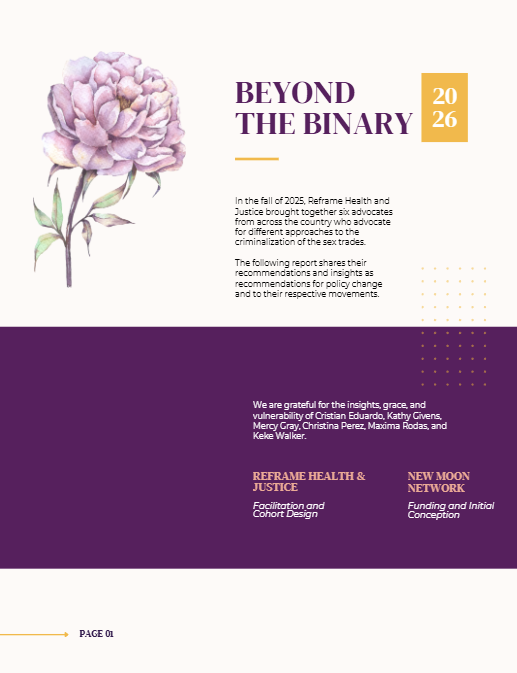
Beyond the Binary
Click here to read the final recommendations report
In the fall of 2025, New Moon Network and Reframe Health and Justice brought together six advocates from across the country who advocate for different approaches to the criminalization of the sex trades.
The report shares their recommendations and insights as recommendations for policy change and to their respective movements.
Read New Moon Network’s full report on the Common Cause Initiative here on Substack.
Key Findings: Consensus Through Shared Values
Despite entering the process with fundamentally different goals regarding the future of sex trade policy, the Common Cause Initiative cohort achieved a consensus on core values and specific policy actions:
A Unifying Value Proposition:
The group identified a foundational principle that transcended their ideological differences: Everyone, regardless of their experience in the sex trade, deserves safety, non-judgment, and care. This agreement validated every participant’s lived experience as legitimate, dismantling the hierarchies such as "deserving" vs. "undeserving" or “credible” vs. “not credible” that has long plagued the field.
Tangible Policy Outcomes:
Moving from values to action, the cohort collaborated to produce six specific policy recommendations. These priorities, spanning issues from immigration reform to service funding, represent a unified agenda that both sides of the movement can support. While some of these recommendations are explicitly about the sex trade, some address basic human needs essential for preventing exploitation or promoting healing, stability and well-being. This output demonstrates that when advocacy is centered on human dignity rather than ideological purity, actionable policy pathways emerge.
RECOMMENDATIONS:
All people deserve access to a diverse set of non-judgmental and affirming services, regardless of their lived experience and respect for self-identification, and without conditions of involvement in criminal-legal proceedings or to stop trading sex. Funding should seek to transparently support culturally responsive services to groups disproportionately impacted by exploitation, including communities of color and trans communities.
Robust, long-term, and ongoing quality healthcare should be free and accessible to all people, including those without documentation or irregular migration status.
We categorically opposed the expansion of criminalization for people who sell sex. We recommend that jurisdictions allocate and/or expand funding and resources for people looking to leave the sex trade, and for those looking to create safety under criminalization while trading sex.
Law enforcement should be banned from engaging in any sexual contact with a potential witness, victim, victim-offender, or perpetrator during investigations of a crime.
Access to affordable and free housing should be expanded for individuals with lived experience in the sex trades.
Prostitution and Solicitation should not be deportable offenses.
We invite funders to consider how their portfolios can support similar bridge-building initiatives such as this one. In this time of crisis and political divide, recognizing our shared humanity and identifying what we all agree on is essential. The return on investment is not just in policy changes, but in the restoration of dignity, the healing of community wounds, and the creation of a more effective, unified movement for justice.